They support applications ranging from aerial mapping and environmental monitoring to maritime surveillance and cargo transport. Here, we explain how they work, their advantages and limitations, and the role of flight testing.
How Do Fixed-Wing Drones Work?
A motor and propeller typically provide forward thrust, while airflow over the wings generates lift. Control surfaces, such as ailerons, elevators and a rudder, allow the aircraft to turn, climb and descend.
Onboard flight controllers can manage stability and navigation, allowing the drone to follow a planned route under human supervision. Some aircraft are remotely piloted throughout the flight, while others use more automated systems.
Unlike a conventional multirotor drone, a fixed-wing aircraft generally needs to maintain forward airspeed to stay airborne. It cannot stop and hover over a single location.
Fixed-Wing vs Multirotor Drones
Fixed-wing and multirotor drones suit different tasks. Multirotors can take off vertically, hover and manoeuvre precisely in confined spaces. This makes them useful for close inspection, photography and work requiring stationary positioning.
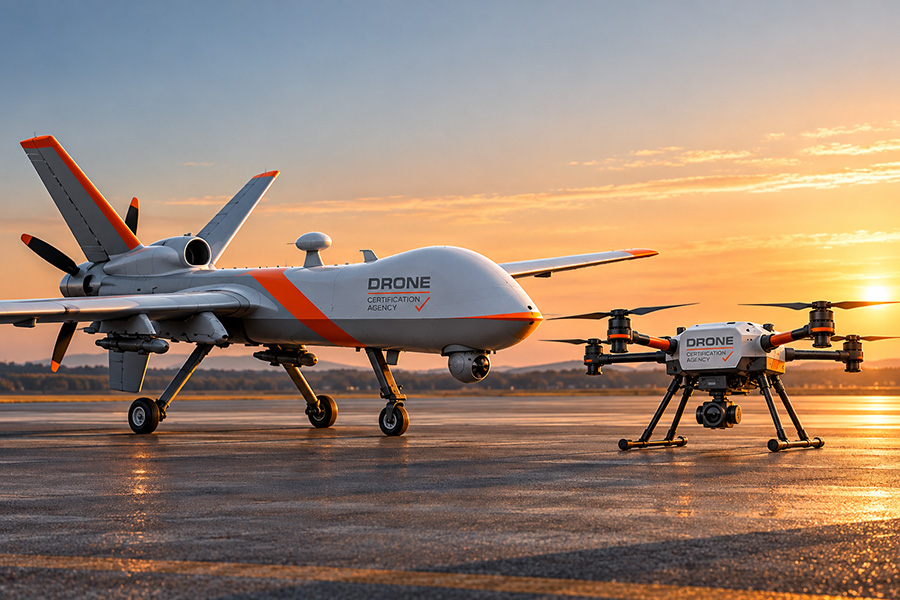
Fixed-wing drones are better suited to sustained forward flight. Their wings generate lift efficiently, allowing them to cover larger areas and travel further. Conventional designs, however, need suitable space or equipment for take-off and landing.
The choice depends on the mission, operating environment and payload.
Advantages & Limitations
The main advantages of fixed-wing drones are endurance, range and efficient area coverage. For surveying large sites or monitoring long stretches of infrastructure, this can reduce the number of flights required.
Depending on their design, they can carry high-resolution cameras, thermal sensors, mapping equipment and communications systems. Payload weight and power requirements affect performance, so equipment must be selected and integrated carefully.
Their limitations include an inability to hover and more demanding launch and recovery arrangements. Some aircraft require a runway, launcher or dedicated recovery system. Weather, available ground space and support infrastructure can also influence where they operate.
What is a VTOL Fixed-Wing Drone?
VTOL stands for vertical take-off and landing. These aircraft combine vertical launch and landing with the efficient forward flight of a fixed-wing design.
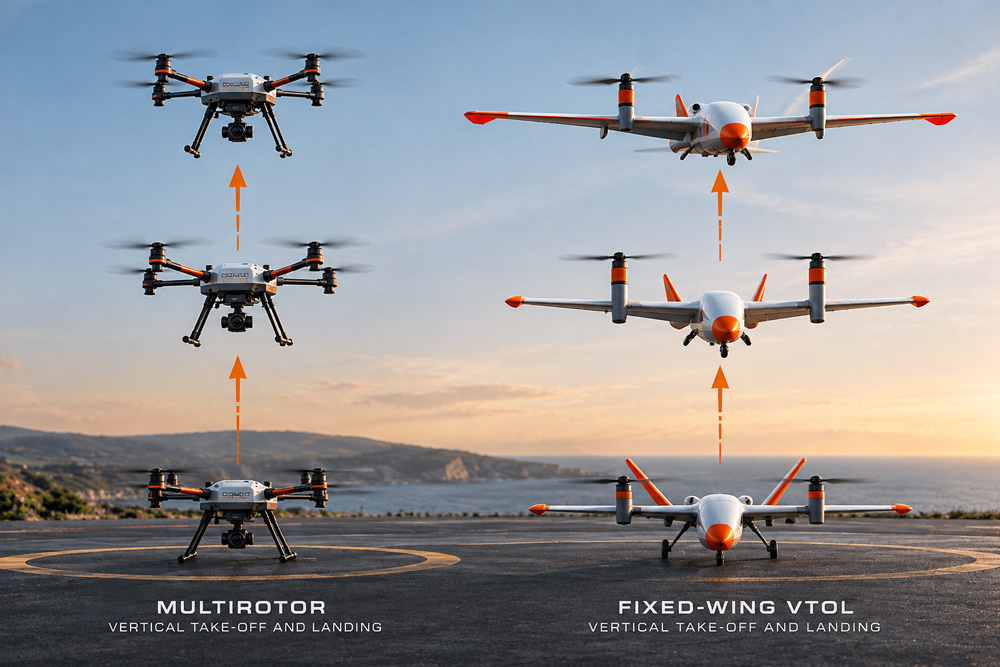
They typically use additional rotors or specialised propulsion systems to lift vertically before transitioning to wing-supported flight. This makes them useful in remote locations, maritime environments and places without runway access.
The additional equipment adds weight and complexity, while the transition between flight modes requires careful engineering and testing.
What Are Fixed-Wing Drones Used For?
Fixed-wing drones are particularly useful where the task involves covering distance:
Aerial Surveying and Mapping
Fixed-wing UAS can efficiently cover large geographical areas, collecting high-resolution imagery and geographical data for mapping, land management and environmental assessment. Their extended flight endurance makes them particularly suitable for surveying large sites, remote landscapes and areas that would otherwise be difficult or time-consuming to access. Equipped with specialist cameras and mapping sensors, these aircraft can support the creation of detailed maps, 3D terrain models and accurate geographical surveys, helping organisations monitor land use, assess changes and make informed decisions.
Agriculture and Environmental Monitoring
Drones equipped with specialist sensors can support crop monitoring, habitat surveys, forestry management and environmental research. Fixed-wing aircraft are particularly effective when surveying large agricultural areas, where their operating range and flight efficiency allow extensive coverage during a single mission. Using multispectral cameras and other imaging technologies, these drones can help identify variations in crop health, monitor vegetation, assess environmental changes and collect valuable data for conservation projects, supporting more efficient land management and sustainable agricultural practices.
Infrastructure Inspection
Long-range unmanned aircraft can support the inspection and monitoring of pipelines, railways, power networks and other extensive infrastructure. Fixed-wing drones are particularly useful for surveying linear assets that stretch across considerable distances, reducing the need for repeated ground-based inspections. Equipped with high-resolution cameras, thermal imaging systems and other specialist sensors, these aircraft can help identify potential defects, monitor asset conditions and provide valuable information for maintenance planning. Their ability to cover large areas efficiently can also help reduce operational costs and limit the need for personnel to access hazardous or remote locations.
Maritime Surveillance
Fixed-wing drones offer significant potential for monitoring coastal waters, shipping activity and offshore infrastructure. Their extended flight endurance and operating range make them particularly suitable for observing large areas of open water, where conventional monitoring methods can be resource-intensive. Equipped with high-resolution cameras, thermal imaging sensors and maritime surveillance equipment, these aircraft can support vessel monitoring, environmental protection, offshore inspections and maritime security operations. As BVLOS capabilities continue to develop, fixed-wing UAS are also becoming increasingly relevant to long-distance maritime missions, including monitoring remote offshore assets and supporting search and rescue activities.
Search and Rescue
Unmanned aircraft can support search and rescue activities by collecting aerial imagery, monitoring large search areas and helping teams assess difficult terrain. Fixed-wing drones are particularly useful for covering extensive areas of coastline, open water and remote countryside, where their longer flight endurance and operating range offer valuable advantages. Equipped with high-resolution cameras, thermal imaging sensors and other specialist equipment, these aircraft can help locate missing persons, identify hazards and provide real-time information to emergency response teams, improving the efficiency and safety of search and rescue operations.
Logistics and Cargo Transport
Fixed-wing and hybrid VTOL drones are also being developed for cargo delivery, including operations connecting remote locations and supporting maritime logistics. These applications may require advanced navigation, communications, payload integration and BVLOS capabilities.
What about BVLOS operations?
Beyond visual line of sight (BVLOS) means flying beyond the remote pilot’s direct visual range. Fixed-wing drones’ endurance and range make them useful candidates for these missions, but technical capability alone does not establish permission to operate.
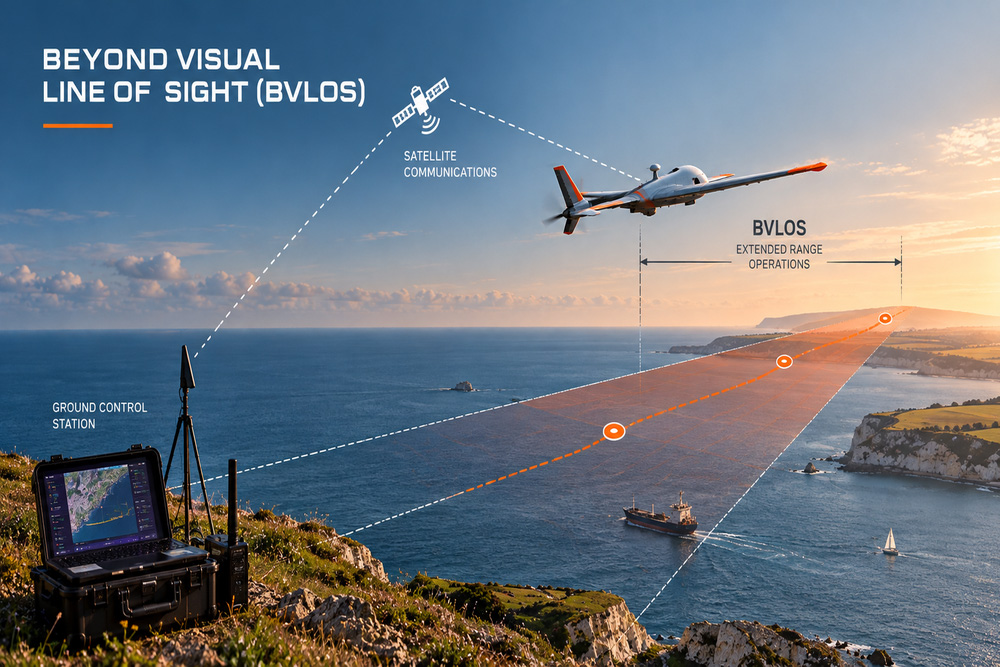
BVLOS operations require appropriate authorisations and careful consideration of communications, airspace interactions and emergency procedures. Flight testing helps developers evaluate these capabilities before progressing to more complex missions.
Why is Fixed-Wing Drone Testing Important?
Testing helps manufacturers, developers and operators understand an aircraft’s performance and limitations. It can assess flight stability, endurance, navigation, communications, payload integration and emergency procedures.
Launch and recovery also need evaluation, along with the transition between vertical and forward flight for hybrid VTOL aircraft. A structured testing programme provides evidence to support development and operational safety assessments.
Drone Certification Agency supports UAS development and testing from Portland Heliport in Dorset. Its aviation facilities, maritime setting and operational support can assist fixed-wing, multirotor and hybrid VTOL programmes, subject to each operation’s requirements and suitability.
Contact DCA to discuss facilities and support for your testing programme.